During our work, it frequently seems that investors and creators (our name for those raising funds) – who should by definition be working towards finding together – spend significant energy NOT to achieve that result. At least that’s the superficial impression – so what are the issues?

Investors first: fact is, they get swamped with 1,000s of funding applications daily, weekly or monthly. In this high-pressured environment, days do not have enough hours to handle the influx, and applications are frequently mistargeted. Creators do not validate what type of investor they are contacting, clearly published theses, preferences (geography, investment stage, type of project, type of funders sought, stated size of typical investment to name but a few) – scattergun approach instead of homework well done. In reaction, many investors automate the first vetting through application systems, take a low profile (no way to contact them) and refuse cold contacting, instead insisting on “warm introductions”. Who could blame them?
Thus, potentially great opportunities are missed. How many “slipped through the net”? Automated systems pull out mismatches by parameters, not by thinking or reading between the lines. Automation is great – but has limits, as has time. Investors might never know about a missed opportunity but there could be those they would have liked to ponder - if time / resources were less constrained.
Moving to Creators: they spend immense time & heart blood preparing their case as best as they can. They are enthusiastic, motivated and convinced! Then they move on to contacting hundreds and hundreds of potential investors - and never hear back. Frustration, time and rare cash slipping away under their hands whilst bootstrapping or continuing to operate without that new product or expansion which would step change that great idea or strategy.

Here is the reality: even if their pitch deck is looked at, it frequently focuses on the great idea in many colours (see picture) but lacks on the pragmatic side (data, facts and figures) which is what investors are looking for. An application must pass through initial (often automated) investor profile vetting. Only then it needs to convince – fast, structured and with the information relevant to investors. Believe us, problems solved with a new idea, CSR philosophies and making the world a better place are important – but not without a market, derived financial case and realistic returns. If that part is nebulous, the investor shuts down. Remember: investment requires returns, not unfounded promises.
Finally, let’s touch on intermediaries (advisors, agents, platforms) trying to bridge the abyss. Their situation is much like that of a Creator, but that they bring experience, networks and investor contacts – which potentially makes a cold call a warm introduction. But they want to protect their network and will only approach contacts if they are convinced; which requires at least initial due diligence costing time and money. Then “coffee chats” and lunches start; which is time consuming – a scarce resource for creators. Depending on the idea stage, there are limited funds and time available for due diligence research, studies, etc. – particularly when the idea is totally new for which information is limited. That’s the clash: intermediaries do not want to carry advance cost and creators cannot – until funds are raised.
How can the dilemma be addressed and the success rate be increased for all parties? In our experience, a way forward is to holistically combine several areas – none of which are new or rocket science.
A good balance between automation and human touch – on all sides. That’s not “old school”, it is good communication. A good talk beats a WhatsApp message anytime.
A pragmatic “data, facts and figures” basis before going public – even if it is done in house (beyond Google KI please!) Convincing research demonstrates clear understanding. Well-structured projections result in convincing financials. Demonstrate and state that!
Targeted investor searches instead of shooting wide – checking their requirements before contacting. Producing a tailored approach goes a long way. Focus on key points and hold your ammunition for the next step – and say that you did all that when first contacting.
Along the way: clear open talk instead of niceties and vague promises. That’s not impolite, but honest and efficient for everyone – and much more convincing.
There are many suggestions on how to present a case to investors, how they “tick” and what they are looking for – some free of charge, some at cost, some even from the investors themselves. And they differ quite widely in expectations, key points to address and where to emphasise.
We always liked the “5 P’s” framework. It covers 5 themes for evaluating an opportunity: People (team), Philosophy (idea), Performance (quantification), Process (implementation) and Portfolio (future strategy/exit). This is not new, not rocket science but certainly holistic.
Whilst the 5P approach is known and accepted in the industry, the emphasis should never be on the model per se, but on coverage of all relevant aspects holistically. So, we expanded it:
People: Founder / Strategy Review
Philosophy: Concept evaluation, including innovation level, USPs, reality checks
Portfolio: Project Status Verification, planning process, future strategy and options
Performance: Market assessment, projections (target segments, competition), DCF Appraisal
Process: Due Diligence checks, scored results, observations, recommendations
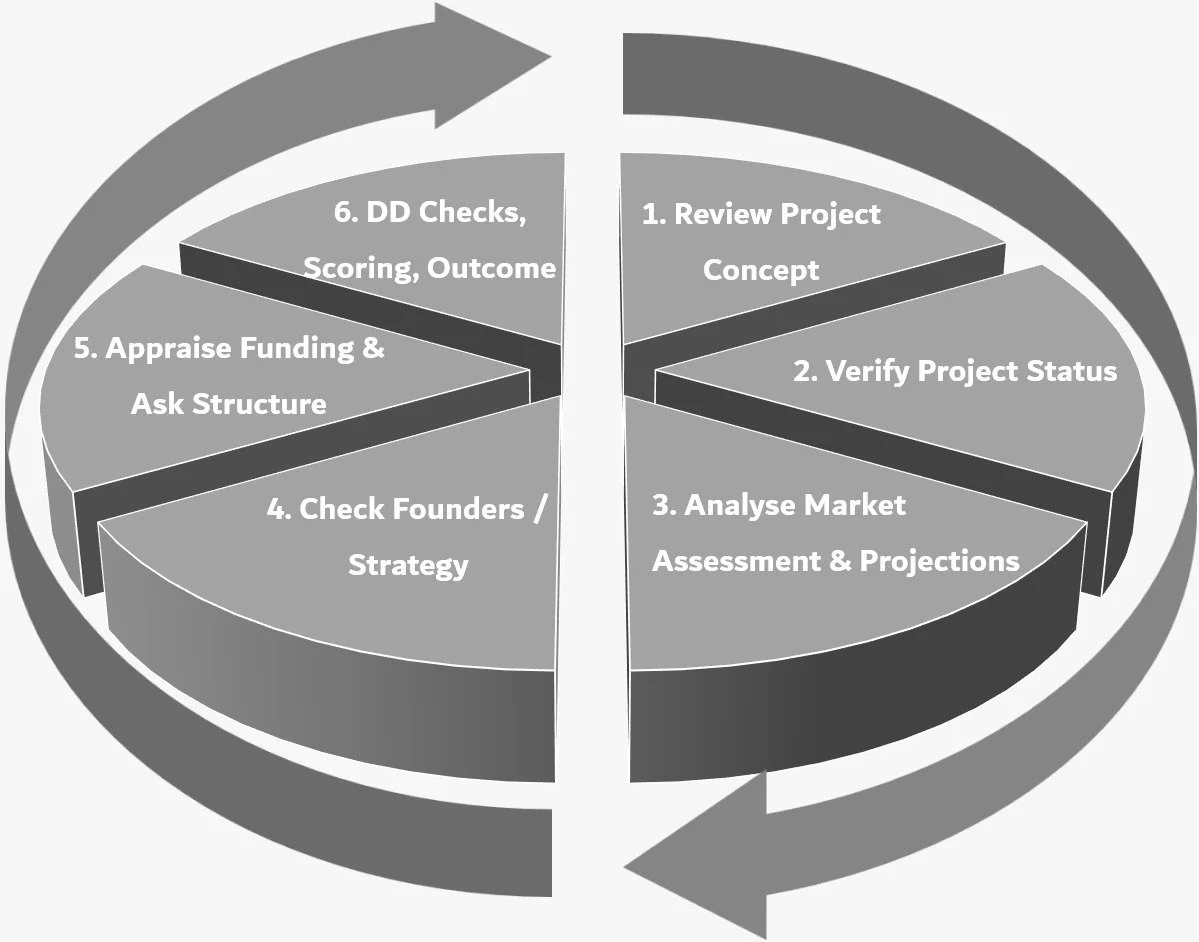
Over time, we converted this into a matrix with different levels of depth (deepening due diligence as a potential deal progresses and also considering stage and size of ask) based on a scoring system.
This allows us to balance good opportunities with declared investor theses and automatic process with human interest (the level matrix serves that well). Add open feedback, emphasis on data facts and figures, pragmatism and realistic time frames. Stepped levels with clear and scored parameters coupled with transparent feedback and clear responses make the tool ideal for both sides. It also saves time by applying appropriate depth at the right points. Especially early creators do not have months, nor can they provide the deep levels of data that for instance a Series C stage requires.
We also use the tool working with Creators as an affordable preparation. It eliminates gaps before going public and improves chances when presenting – by giving reassurance to investors that there has already been an initial due diligence and vetting by a professional third party.
Sven Gade is a veteran in raising finance as well as investing for both clients and himself for over 30 years and brings his and MCI CLT’s deep understanding to our clients.